
Adv. Mater., 2017, 1700665.
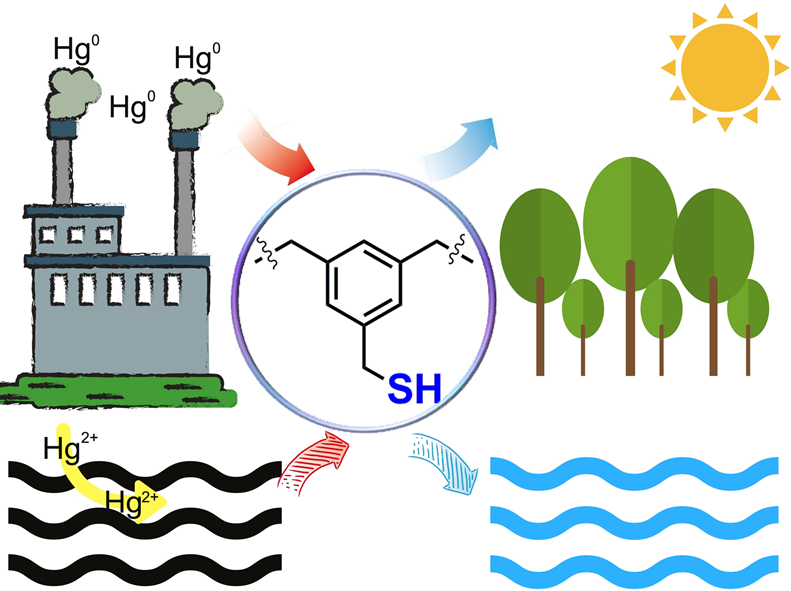
Efficientmercury capture using functionalized porous organic polymer.
The primary challenge in materialsdesign and synthesis is achieving the balance between performance and economyfor real‐world application. This issue is addressed by creating a thiolfunctionalized porous organic polymer (POP) using simple free radicalpolymerization techniques to prepare a cost‐effective material with a highdensity of chelating sites designed for mercury capture and thereforeenvironmental remediation. The resulting POP is able to remove aqueous andairborne mercury with uptake capacities of 1216 and 630 mg g−1, respectively. The materialdemonstrates rapid kinetics, capable of dropping the mercury concentration from5 ppm to 1 ppb, lower than the US Environmental Protection Agency's drinkingwater limit (2 ppb), within 10 min. Furthermore, the material has the addedbenefits of recyclability, stability in a broad pH range, and selectivity fortoxic metals. These results are attributed to the material's physicalproperties, which include hierarchical porosity, a high density of chelatingsites, and the material's robustness, which improve the thiol availability tobind with mercury as determined by X‐ray photoelectron spectroscopy and X‐rayabsorption fine structure studies. The work provides promising results for POPsas an economical material for multiple environmental remediation applications.