
J. Am. Chem. Soc., 2017, 139, 2786-2793.
Post-syntheticallymodified covalent organic frameworks for efficient and effective mercuryremoval.
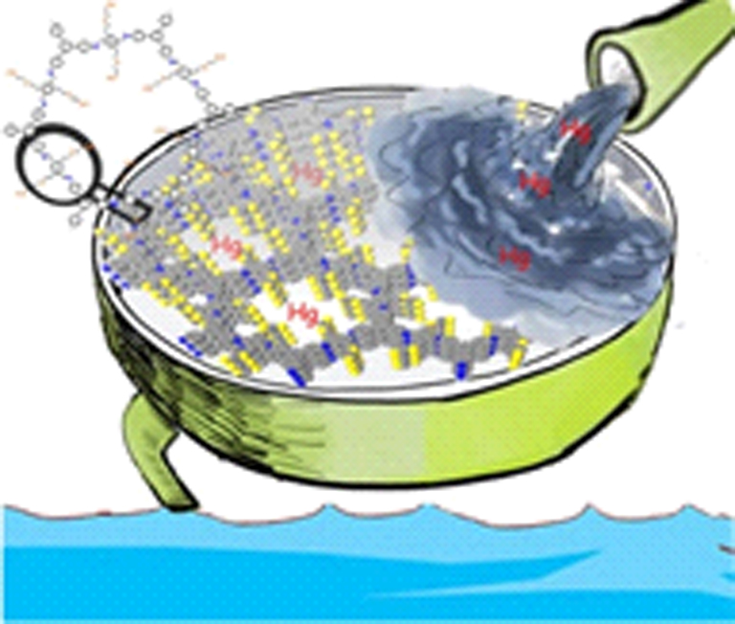
A key challenge in environmentalremediation is the design of adsorbents bearing an abundance of accessiblechelating sites with high affinity, to achieve both rapid uptake and highcapacity for the contaminants. Herein, we demonstrate how two-dimensionalcovalent organic frameworks (COFs) with well-defined mesoporestructures display the right combination of properties to serve as a scaffoldfor decorating coordination sites to create ideal adsorbents. Theproof-of-concept design is illustrated by modifying sulfur derivatives on anewly designed vinyl-functionalized mesoporous COF (COF-V) via thiol-ene"click" reaction. Representatively, the material (COF-S-SH)synthesized by treating COF-V with 1,2-ethanedithiol exhibits high efficiencyin removing mercury from aqueous solutions and the air, affording Hg2+ and Hg0capacities of 1350 and 863 mg g-1, respectively, surpassing all those of thioland thioetherfunctionalized materials reported thus far. More significantly, COF-S-SHdemonstrates an ultrahigh distribution coefficient value (Kd) of2.3 × 109 mL g-1, which allows it to rapidly reduce the Hg2+ concentration from5 ppm to less than 0.1 ppb, well below the acceptable limit in drinking water(2 ppb). We attribute the impressive performance to the synergistic effectsarising from densely populated chelating groups with a strong binding abilitywithin ordered mesopores thatallow rapid diffusion of mercury species throughout the material. X-rayabsorption fine structure (XAFS) spectroscopic studies revealed that each Hg isbound exclusively by two S via intramolecular cooperativity in COF-S-SH,further interpreting its excellent affinity. The results presented here thusreveal the exceptional potential of COFs for high-performance environmentalremediation.