
Acc. Chem. Res., 2020, 53, 812-821.
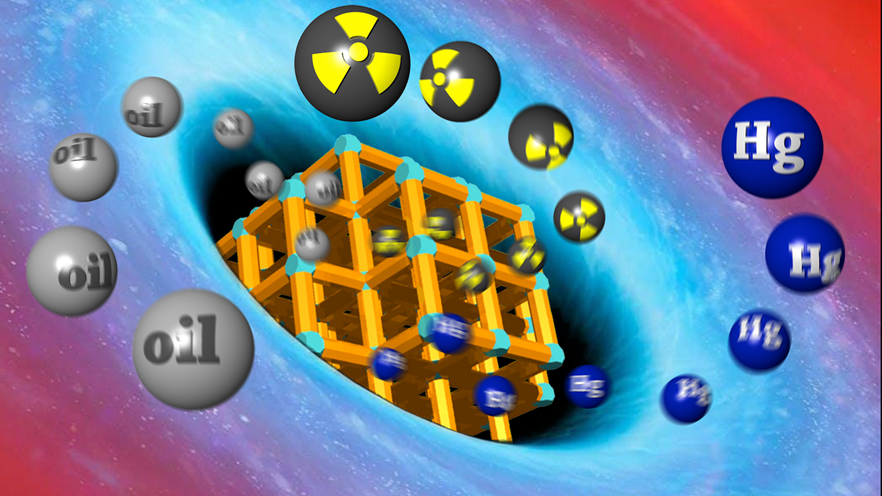
Tailored porous organic polymers fortask-specific water purification.
The Industrial Revolution has resulted in social and economic improvements, butunfortunately, with the development of manufacturing and mining, water sourceshave been pervaded with contaminants, putting Earth's freshwater supply inperil. Therefore, the segregation of pollutants-such as radionuclides, heavymetals, and oil spills-from water streams, has become a pertinent problem.Attempts have been made to extract these pollutants through chemicalprecipitation, sorbents, and membranes. The limitations of the currentremediation methods, including the generation of a considerable volume ofchemical sludge as well as low uptake capacity and/or selectivity, actuate theneed for materials innovation. These insufficiencies have provoked our interestin the exploration of porous organic polymers (POPs) for water treatment. Thiscategory of porous material has been at the forefront of materials research dueto its modular nature, i.e., its tunable functionality and tailorable porosity.Compared to other materials, the practicality of POPs comes from their purelyorganic composition, which lends to their stability and ease of synthesis. Thepotential of using POPs as a design platform for solid extractors is closelyassociated with the ease with which their pore space can be functionalized withhigh densities of strong adsorption sites, resulting in a material that retainsits robustness while providing specified interactions depending on thecontaminant of choice.POPsraise opportunities to improve current or enable new technologies to achievesafer water. In this Account, we describe some of our efforts toward theexploitation of the unique properties of POPs for improving water purificationby answering key questions and proposing research opportunities. The designstrategies and principles involved for functionalizing POPs include thefollowing: increasing the density and flexibility of the chelator toenhance their cooperation, introducing the secondary sphere modifiers toreinforce the primary binding, and enforcing the orientation of the ligands inthe pore channel to increase the accessibility and cooperation of thefunctionalities. For each strategy, we first describe its chemical basis,followed by presenting examples that convey the underlying concepts, givingrise to functional materials that are beyond the traditional ones, asdemonstrated by radionuclide sequestration, heavy metal decontamination, andoil-spill cleanup. Our endeavors to explore the applicability of POPs to dealwith these high-priority contaminants are expected to impact personal consumerwater purifiers, industrial wastewater management systems, and nuclear wastemanagement. In our view, more exciting will be new applications and newexamples of the functionalization strategies made by creatively merging thestrategies mentioned above, enabling increasingly selective binding andefficiency and ultimately promoting POPs for practical applications to enhancewater security.