
ChemCatChem, 2020, 12, 3285-3289.
Turningon catalysis: construction of triphenylphosphine moieties into porous frameworks.
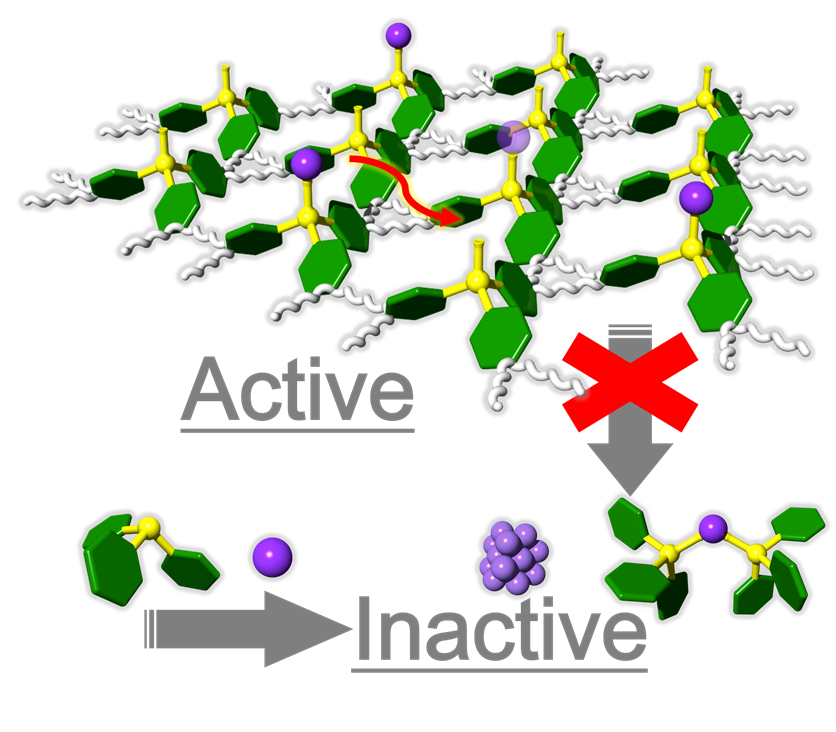
Inthis work, we present an effective strategy to enhance the reactivity anddurability of molecular organometallic catalysts by constructing into porousframeworks, as demonstrated by triphenylphosphine (PPh3). Such PPh3 moieties accessiblevia the porous structures could be partially metalated by Pd species to generate a highly efficientand recyclable heterogeneous catalyst for the Suzuki coupling of arylchlorides. Site isolation in the rigid framework stabilizes the catalyticallyactive monophosphine‐ligated complex against deactivationinto less active assemblies of bisphosphine‐Pd. Meanwhile, the densely populatedfree ligands inhibit the decomposition of catalytically active sites therebyhighlighting the beneficial effects of such a platform. Thus, the tunability of porous polymer synthesis gives greatpromise to impart numerous organometallic catalysts constituted by readilyavailable ligands with unique reactivity, which are not trivially achievablewith traditional systems.