
ACS Appl. Mater. Interfaces, 2020, 12, 32827-32833.
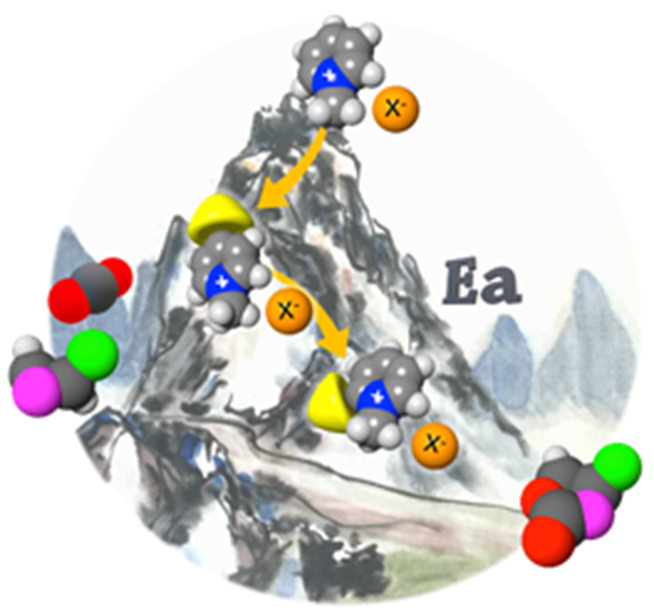
Secondarysphere effects on porous polymeric organocatalysts for CO2 transformations: subtlemodifications resulting in superior performance.
Albeitharnessing secondary sphere interactions to exert control over the reactionoutcomes has primarily been applied to enzymatic and organometallic catalysis,there are seldom any studies that introduce outer-sphere modifiers into organocatalysts. This is even less in the correspondingheterogeneous catalytic system. In this contribution, we experimentally andcomputationally investigate the role of secondary effects in the reactivity ofbromide anions toward CO2 transformations. Six pyridinium cationic porous frameworks have beensynthesized and fully characterized. Structure–activity relationships andkinetics show that the type and the location of the substituents on thecationic framework have a significant impact on the nucleophilic reactivity oftheir bromide counter anion. Specifically, the attachment of amine substituentto the ortho position relative to a pyridinium motif produces a remarkably efficientcatalyst for CO2 transformation, by a factor of six times greater in comparisonto the pristine pyridinium-based polymer. Thehydrogen-bond-interaction-promoted reagent activation and enhanceddelocalization ability of bromide counter anion are believed to be the key todriving the reaction toward CO2 utilization. These observations, therefore,champion the leverage of secondary interaction for optimizing the reactivity of organocatalysts.